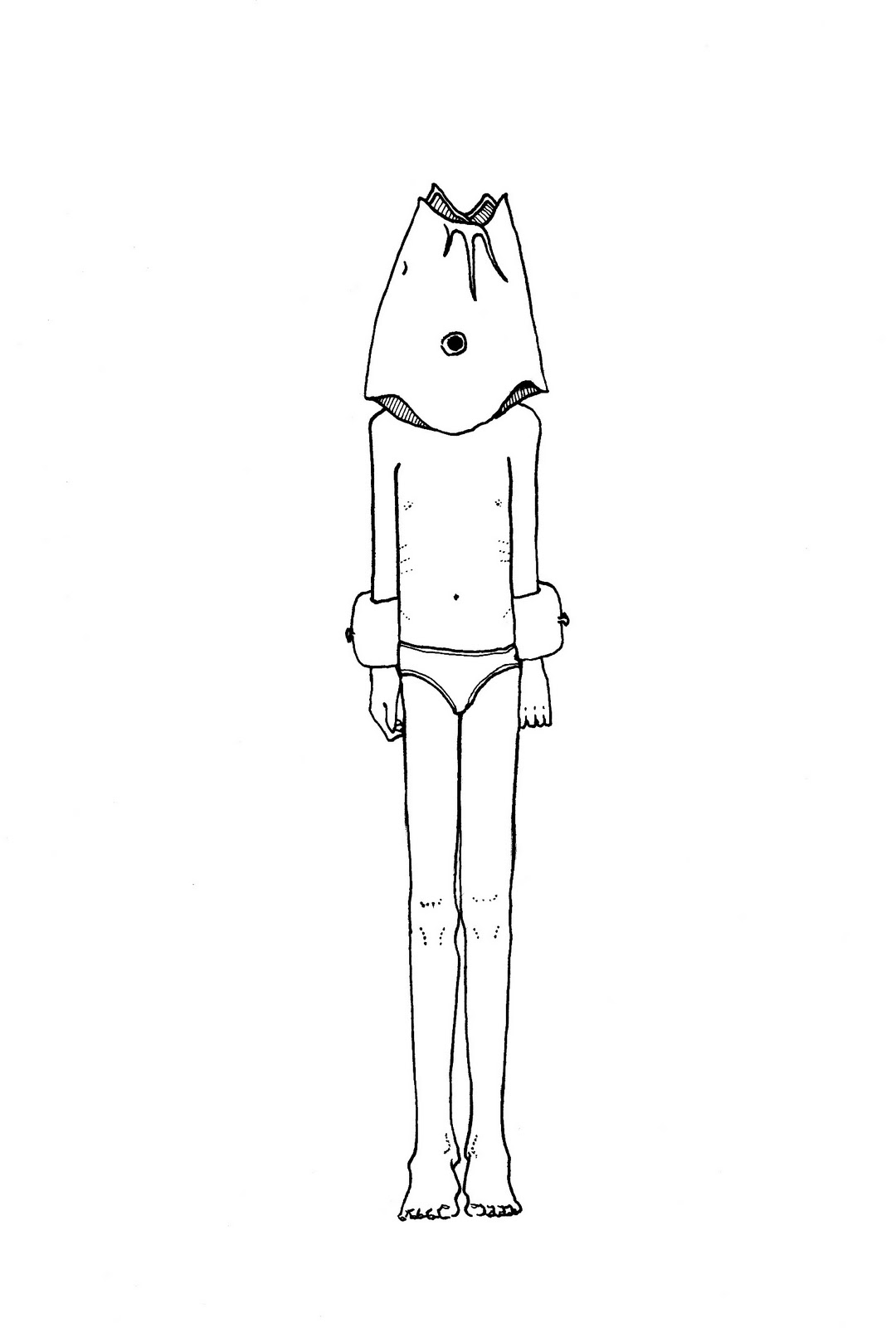
Scenes in the Life of Rupert Gills, Born with the Head of a Fish
DISCOVERY
One windy morning, Fiona Gills walks on the beach when she sees an unusual creature tumbling in the surf. She walks close to the thing and is greeted by the strangest sight: a baby boy with the head of a fish. The baby moves with the confused inarticulations of a natural accident, at times flopping and at times seeming to crawl. Fiona looks for passersby on the beach, then sweeps the fishchild up in her shawl and goes on her way.
"I will call you Rupert," she says.
SWIM CLASS
Little Rupert Gills excels in swim class. Outfitted with floaties like the rest of the kids, Rupert soon proves his aquatic aptitude, snaking through the water as the other kids kick at the surface. He stays under for impressively long durations, to the terror of a few young lifeguards, who pull Rupert out several times. "Oh, he just does that," his mother Fiona says to the concerned staff. "He has gills and human lungs, you see, and can breathe well in and out of pool." She continues his enrollment because he likes the water.
KIDS CAN BE CRUEL
Pete Ganz and Patrick Magnuson can barely hold their giggles in as they slip a fish hook into the PB&J. "Quick," Pete says, "he's coming."
Into the cafeteria walks the freakish Rupert Gills, who won't stop looking weird no matter how many conditionings and tolerance talks the teachers give.
"Hey Rupe!" Patrick calls to the fish. "Here, I made this for you."
He carries the sandwich to Rupert while Pete hides behind with fishing line in hand. Rupert, surprised, takes the sandwich and starts to feast. Pete waits for the right bite then tugs on the line, jerking Rupert from the jaw.
The two bullies cackle until Rupert very shortly begins to make horrible choking noises, gagging on blood no doubt, and what seemed like an innocent prank to the two sixth graders turns into this really miserable ordeal for everyone involved. The school nurse intervenes, then the principle, and Pete and Patrick are never seen again at River View Elementary.
Rupert, meanwhile, learns to take advantage of having an eye on each side of his head. Bullies stop attempting to approach him from behind. He may be feeble, they learn, but he can see you.
SHAVING
Rupert does not have to, actually.
A BIG HIT WITH SIGMA ALPHA EPSILON
Rupert decides to join a frat as a freshman at UCLA. He rushes for Sigma Alpha Epsilon and, like everyone, is hazed. The dudes pull out their usual assortment of embarrassing initiations, blindfolds and absurd alcoholic consumption and so on, and are amazed to see just how well Rupert can endure the usually devastating water hazing. He can drink and drink and drink water and never let up.
So Rupert becomes a minor celebrity at SAE and is seen at all the big frat parties. People find him endearing. When he drinks too much beer he does that gasping thing fish do out of water and people get alarmed, but otherwise the general consensus is that he's pretty chill to have around.
THE BLIND DATE
In his second year at UCLA, a couple of friends set Rupert up on a blind date with a girl named Carla Stump. "You guys'll get along famously," the friends say. They set the two up to eat at Santori Sushi — her favorite.
Rupert arrives first. He gets some weird looks; he ignores them. He doesn't mind eating other fish.
He sees a chubby girl dressed very nicely sitting solo, walks up to her, and asks: "Carla?"
Carla's eyes widen. "Is this some kind of sick joke?!" She rises from her seat and shrieks to the sushi chefs. "What kind of sick fucks would do this to me?!" Her eyes are pearled with tears.
"Carla, wait —" Rupert, not knowing what to do, grabs her and goes in for a kiss.
She vomits all over his suit.
"Leave me alone," she manages, and storms out the restaurant.
Rupert later learns that Carla has been set up on numerous nightmare dates like this. He begins to wonder what his friends really think of him.
WISTFUL MOMENTS
Rupert, 26, goes to the beach the afternoon after Fiona Gills' funeral. Tears drip from his scales. This is where she found him, she told him towards the end of her life, but though Rupert did not actually come from his mother, this did not make her love him any less.
Rupert, on the shore, feels he belongs neither on the land nor the ocean ahead. All he feels is the incredible throb of longing for the home he lost.
TRUE LOVE?
Rupert sits at the bus stop. He works now for Sierra Fisheries. Somehow — he could not say exactly how — he knew where all the commercial fish schooled, and has proven to be a valuable resource for the company.
A woman sits next to him. She has a head of tentacles, big black eyes, and speaks from a beak. "Excuse me," she says. "I'm new here. Will the 319 take me to the harbor?"
"Yes it will," Rupert says. "That's where I'm headed."
"Wonderful," she says.
So finally, at 35, Rupert's life starts to make a little more sense.